About
Kachinas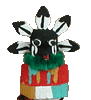
A
kachina has three aspects. The supernatural being as it exists in the minds
of the Hopis; the masked impersonator of the supernatural spirit; and the
dolls that are made in the likeness of the masked impersonator of the supernatural
spirit.
Kachinas represent the forces
of nature, human, animal, plant, and act as intermediaries between the world of
humans and the gods. Kachinas play an important part in the seasonal ceremonies
of the Hopi. They represent generations of traditions that have been passed on
and are the subject of a number of books. The simplified descriptions of the individual
kachina dolls here is meant only as an introduction.
Small
kachinas (dolls) are given to children to introduce the child to what each of
the kachinas look like.
Traditionally,
kachina dolls are created by Hopi or Zuni artists.
Antelope
- The antelope is believed to bring rain and make the grass grow so that there
will be plenty of feed for wild game.
Badger
- Animals are advisers; the badger is a curing kachina with a connection to roots
and herbs and an ability to heal the sick with prayers.
Butterfly
- Not actually a kachina but a maiden who is dressed like a butterfly to participate
in social (not ceremonial) dances, symbolizing the coming of spring, when butterflies
migrate onto the corn fields and there is the gathering of rain clouds.
Cloud
- Cloud appears in Mixed Kachina Dance and is said to bring summer rains.
Crazy
Rattle - AKA Crazy Rattle Runner, this kachina uses yucca to swat runners
who lose a race. Those who win get piki bread.
Eagle
(Kwahu or Kwa Kachina) dances to imitate the eagles in appearance and movement
as a prayer for more eagles. Eagles are treasured guests and are given gifts.
Hemis
- Used in the Niman Kachina Dance, Hemis is also often referred to as the Niman
Kachina. The Niman Kachina dance takes place in July, the time of ripened corn.
Kokopelli
- A flute player with a hump back which some say represents his backpack full
of gifts to distribute. He is the kachina or happiness and joy; his flute playing
brings rain and draws women, so the kokopelli is regarded as a "baby maker",
a symbol of fertility.
Longbill -
Longbill appears during the Bean Dance Ceremonies and sometimes stands guard
on the kiva when secret ceremonies are taking place.
Morning
Singer - Also known as Early Morning Kachina and Talavai, Morning Singer appears
on rooftops in the early morning and sings happy, sad or critical songs.
Racer
Snake will be in one place one second and in another place a fraction of a
second later, much like the slender racer snake that lives in the desert.
Sun
God travels the sky every day, ending his trip in the
kiva of the Woman of Hard Substances in the Pacific Ocean. Young, handsome, gentle,
kind and helpful, he never mingles with people.
White
Bear - Appears in mixed dances, a powerful and healing kachina.


 Click on an item below for details and to order.