Dry
Creek Turquoise in Native American Indian Jewelry©
2011 Horsekeeping LLC ©
Copyright Information The following article
is reprinted for historical interest. Note that the author does not differentiate
between Dry Creek Turquoise, which is pale blue and a true turquoise, and White
Buffalo Stone, which has no color and is technically not turquoise.
DRY CREEK
TURQUOISE
Reprinted
from Rockhound Gazette, December 2000
 Also
knows as "White Turquoise"or "Sacred Buffalo Turquoise", Dry
Creek Turquoise has a characteristic white or very pale blue color with brown
flecks in it almost like confetti. Because white turquoise is as rare as the white
buffalo, it is sometimes referred to as Sacred Buffalo Turquoise. White turquoise
was found in the Dry Creek Mine near Battle Mountain, Nevada. The mine is closed.
This stone is very rare and collectible. Also
knows as "White Turquoise"or "Sacred Buffalo Turquoise", Dry
Creek Turquoise has a characteristic white or very pale blue color with brown
flecks in it almost like confetti. Because white turquoise is as rare as the white
buffalo, it is sometimes referred to as Sacred Buffalo Turquoise. White turquoise
was found in the Dry Creek Mine near Battle Mountain, Nevada. The mine is closed.
This stone is very rare and collectible.
When
discovered in the Dry Creek Mine (Note: not it's name today) in the Shoshone Indian
Reservation near Battle Mountain, Nevada in 1993, they (the discoverers) were
not sure what it was. Because of its hardness, it was decided to have it assayed.
Their suspicious proved correct. It was, in fact, white turquoise. It was not
until 1996, however, that it was finally made into jewelry. The
Shoshone Indians are not known for jewelry work and, as a consequence, the Shoshone
sell or trade the white turquoise to the Navaho in Arizona who work it into jewelry.
Because white turquoise is as rare as the white buffalo, some Indians call it
"White Buffalo" turquoise. Important
Note - There is much white with black matrix stone sold that is actually howlite,
which is not turquoise at all. It is often from Mexico or Mexican made and is
often referred to as White Buffalo Turquoise - so you can see the confusion between
the authentic and rare Dry Creek White Turquoise and "White Buffalo"
faux turquoise that is being marketed. Be aware and beware ! 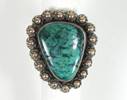 Turquoise
gets its color from the heavy metals in the ground where it forms. Blue turquoise
forms where there is copper present (most Arizona turquoise). Green turquoise
forms where iron is present (most Nevada turquoise). White turquoise, where there
are no heavy metals Turquoise
gets its color from the heavy metals in the ground where it forms. Blue turquoise
forms where there is copper present (most Arizona turquoise). Green turquoise
forms where iron is present (most Nevada turquoise). White turquoise, where there
are no heavy metals present, turns out to be rare. To date no other vein of white turquoise has been
discovered anywhere else. When this current vein runs out that will be the last
of it.
present, turns out to be rare. To date no other vein of white turquoise has been
discovered anywhere else. When this current vein runs out that will be the last
of it.
Read
more about Turquoise and other stones. |