Hello there!
And welcome to Volume 10, Copy Editors
This is the tenth in a series about the state of fiction writing today along with updates on my debut novel, Becoming Amber, which will be released later this year.
To read past newsletters, go here. To sign up for future newsletters, go here.
Copy Editors
A few weeks back, Becoming Amber was handed off from the Developmental Editor to the Copy Editors.
Copy editors go to work after developmental editing and before interior layout. This is when the final changes take place. Hopefully.
You might have noticed I put Copy Editors in the plural form. That is because there are often several copy editors, each performing a particular task.
The three I am most familiar with are:
- Line edit copy editor
- Fact checking copy editor
- Style sheet copy editor
Line Edit Copy Editor
This editor makes suggestions to the author to improve their prose by adjusting flow, cutting extra words, offering other word choices. She might make suggested edits right in the manuscript or as a comment in the margin.
An example would be if the original manuscript contained a sentence like this:
When the bear stood and roared, Bonnie immediately grabbed her rifle and sent a warning shot in the air above the bear's head while scrambling to find cover.
A line editor might suggest this:
Bonnie grabbed her rifle and fired a warning shot into the air above the roaring bear while scrambling for cover.
OK, that was more concise, but it takes us almost to the end of the sentence before we know why Bonnie grabbed her rifle, so I don't think that's quite right.
The author might choose to use this instead:
The bear stood and roared. Bonnie grabbed her rifle and fired a warning shot while scrambling for cover.
With Becoming Amber, there were less than a dozen suggestions or questions about words or phrases. Most of them concerned the use of words that the copy editor questioned as appropriate for the time but they were words known by the author (me!) and used on purpose.
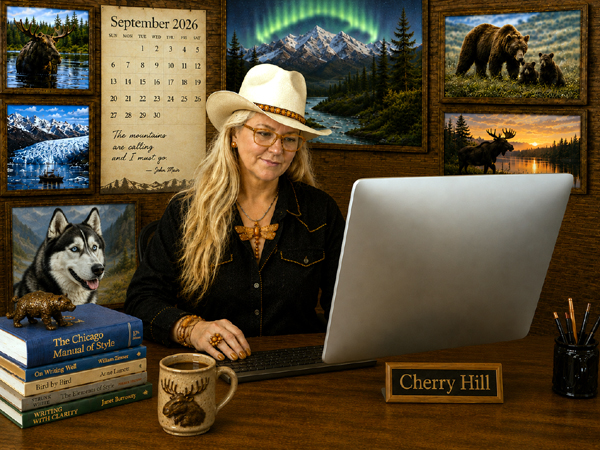
It took me less than an hour to scroll through the editor's comments and either accept, reject or make changes where appropriate. To save my eyes for the many novels that are coming, I wear blue light blocking lenses at my computer.
Example:
Whether to use ax or axe. The book is in English, but there can be quite a variation in words between US English and British English. The preferred spelling for American English is ax.
Fact Checking Copy Editor
This fact-loving person verifies events and times in the story to see if they mesh with real world and historical times and details. Although it is fiction, it bodes well if the author gets songs, books, foods, jargon, political events and the like accurate so it doesn't stop the reader in their tracks.
If Bonnie had said in 1971 Alaska, "I liked nothing better than Honey Nut Cheerios and a banana." that would be a gaffe, since Honey Nut Cheerios didn't come out until 1979.
Example:
The Alaska Canada Highway (officially The Alaska Highway since 1943) has usually been referred to as the Alcan or ALCAN and pronounced AL-kan. I was used to seeing it in all caps when I lived up there and that's the way I wrote it, ALCAN. But, the Chicago Manual of Style, which many editors use as a guide, suggests that acronyms that are pronounced as words (rather than read out as individual letters, like FBI) should be written in upper/lower case: Alcan.
Style Sheet Copy Editor
Good style sheet editors are picky and pay attention to details. They need to be thoroughly familiar with the style guide that the publisher uses. In the case of my book, one of the standards, The Chicago Manual of Style, was the style guide used.
The style sheet copy editor asked me for my preferred style and what I used when preparing the manuscript, and I sent her this so she would know what I intended:
- Page break after each chapter
- Three paragraph spaces to start new chapter
- First line of chapter and sub-sections, no indent
- Letters and notes, italics, no quotes, 1" margins left and right
My style sheet editor looked at all the song titles and lyrics to be sure they were in quotes, and she also caught a few lyrics that were copyrighted so I couldn't use those without permission.
She caught punctuation errors, the most common which were:
- An extra space after a period. There should be only one and sometimes I had two.
- The proper way to write an ellipsis, which is a pause that shows a thought is not completed, or that words are omitted, or a thought is purposely trailing.
Examples are, "She entered the cabin ... but couldn't remember why she was there."
Or "I went into the cabin, hoping to find ... "
With all those details taken care of, next stop is PAGES!!
See my next newsletter on Page Layout along with updates on my debut novel, Becoming Amber.
Past newsletters cover the love of writing, the importance of a good idea, writing the book, looking for a publisher, the Acquisitions Editor, contract terms, the Developmental Editor, and cover design.
Until
then,