Hello there!
And welcome
to Adventures in Fiction Writing - Vol 4
Finding a Publisher
This is the fourth in a series about the state of fiction writing today along with updates on my debut novel, Becoming Amber, which will be released later this year.
My first newsletter covered the love of writing; the second the importance of a good idea, the third, writing the book.
Now it's time to get it published. But, not so fast.
Get Ready for the Long Haul
All novels have their own path and pace. I can only describe my journey.
Books by established novelists are often put right into the pipeline. Yes, that's what they call it, the pipeline (they being the agents, publishers and others who make a manuscript into a book).
Debut novelists, like me, can't even see the pipeline, let alone get into it.
Here's why:
In 2025 there were 4,200,000 books published in the US.
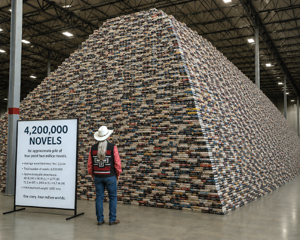
Only 1,500 books out of that 4,2000,000 were considered best-sellers, that is, books that sold more than 20,000 copies.
A book is considered a commercial success if it sells 5,000 copies but only 42,000 of the 4,200,000 books published last year reached that benchmark! That's 1% or only 1 out 100 books.
So in 2025, 99% of published
books didn't break even! That means the publishing expense exceeded the
revenue from sales.
That's why most books go out of print after one year!
I needed a double mug of mushroom coffee after learning that!
Querying Publishers
When I was writing non-fiction horse books, I wrote a one page description of what I had in mind for a book, sent it to a publisher or publishers, and within a few weeks I'd receive a contract in the mail. Then I'd write the book, send a hard copy (yes, printed on paper) and photos (actual prints or slides because it was the pre-digital era) to the publisher and they would publish and promote the book, while I planned the next one. I worked this way with eight different publishers in the 24 years that I wrote 33 non-fiction horse books.
So, I figured I'd just use the same M.O., right?
First I had to identify which publishers to contact. I asked Richard, an avid fiction reader, who his favorite authors were. He gave me a list of six and I wrote a query letter to each of their publishers.
While I waited to hear from them, I searched on the internet for the average time to hear back from a query to a publisher. Estimates were all over the board with many up to 6 months, a lot longer than I was accustomed to or expecting.
However, it was during that search that I learned something even more important.
Most of the largest publishers do not accept unagented queries. The six I had queried were considered the "Big Houses", or their imprints.
I guess that's why I never heard back from them. I had sent unsolicited, unagented queries.
Agent Now
In the past, I was my own agent. I placed my books and negotiated my own publication contracts.
But for fiction, it looked like I shouldn't be contacting publishers, I had to find a middle man, or middle woman as I would come to find was the case. To move forward, everyone said I needed an agent.
Help!
At sea, I contacted my former editor (of horse books) at Hachette Book Group.
First, she suggested I contact a small independent press that she thought would be an ideal fit for my novels. However, they, too, required an agent.
Next, she put me in touch with a project designer at Hachette that I'd worked with on my horse books, and who was also an aspiring novelist. She told me that she got started years before me on fiction, that she finally found an agent who agreed to represent her, but that agent had been unable to place any of her novels with a publisher.
In a last ditch attempt to help, my former horse book editor linked me up with an literary editor at Little, Brown and Company, an imprint of Hachette. My novels are not purely literary fiction, but I hoped he could guide me down the path to publication.
After a few helpful emails back and forth, he suggested we talk on the phone.
Phone? My office in the foothills was a phone-free zone.
At that time, being as remote as we are, we only had one land line phone - in our house. Cell signal was only reliable for a 911 call.

So we set up a time for him to call me at the house.
During a lengthy and very friendly conversation, he told me it was mandatory to have an agent for fiction and he provided me with a list of about 20 "to get you started." He also told me to "cast a wide net," to send my queries to a hundred agents or more and to use a program like Query Tracker to help me keep track of who I'd contacted and when.
"To be honest, though," he told me, "most of the best agents are so busy with books by their current clients that they aren't looking for new talent. You might have to settle for someone new to the profession who is just building their list."
He also told me this: "My brother is a very good writer, every bit as good as the authors we are publishing, and yet he's been trying to get an agent for years with no luck. It is a very competitive business. Books must fit into the genres that are on the agent's and publisher's list. Books they are certain they can place with one of the big houses and that will make money. They are looking for specific genres, a comfortable fit, a best seller."
Genre. See, that's something I've had a hard time with. Although my books contain elements of crime, mystery, domestic suspense, romance, adventure, and more, they are not easily categorized. They are more like a life saga, with all the elements that make up us humans: emotional, physical, intellectual, and spiritual. Add a good crime or two, a murder, a love affair. You get the picture.
I shuddered to think of writing boilerplate fiction.
When I hung up with the Little Brown editor, I must admit, I was discouraged.

I wanted to create, not spend all my time writing query letters to agents and taking care of other mundane business tasks.
But after a day or two to absorb what I'd learned, I did a little more research, bit the bullet, and decided to look for an agent.
See my next newsletter - The Hunt for an Agent, with updates on my debut novel, Becoming Amber.
Until then,