Hello there!
Hello there!
And
welcome to Volume 5, Jump Ahead
This is the fifth in a series about the state of fiction writing today along with updates on my debut novel, Becoming Amber, which will be released later this year.
My first newsletter covered the love of writing;
the second, the importance of a good idea;
the third, writing the book;
and the fourth, looking for a publisher;
If you'd like to read the back issues, go here.
To sign up for future newsletters, go here.
I had said that the next newsletter was going to be The Hunt for an Agent, but it is not.
Things are moving along so quickly with Becoming Amber that I need to jump ahead about a year.
Later on, I'll pick up with the agent topic.
This newsletter begins with an author's manuscript arriving at a publishing house.
Today, virtually all submissions are made electronically via email or web forms as a Microsoft Word document.
Acquisitions Editor
If the publisher does not accept submissions directly from authors, the unsolicited manuscript is deleted, and most often the author doesn't even receive a reply.
If the publisher does accept submissions from authors or if the submission is from an agent, the first place a manuscript lands is the inbox of the Acquisitions Editor.
Stop.
Let me correct that by saying - it arrives at the the inbox of an assistant to the Acquisitions Editor. And, in my experience, 80% of these assistants, or interns, are females between the ages of twenty and thirty.
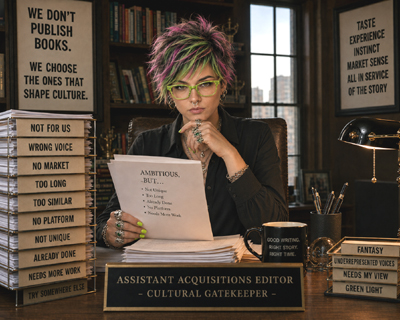
The assistant screens incoming works and either rejects them outright or evaluates them. A good assistant has his or her finger on the pulse of the market and knows the wants and likes of the publisher's editorial board.
Acquisition Editors are typically swamped, and I'm convinced that their assistants look for any reason to pass on a book. For example, they might nix a proposal if the author did not follow submission instructions to the letter, or sent a 1 1/4 page query letter instead of a one page letter. Or didn't format properly. Or was slightly over or under the desired word count.
If the mechanics of the proposal do pass muster, the next things the assistant assesses are the first few pages of the book, the synopsis, pitch, back cover copy, audience, and comps. I'll talk more about those in another newsletter.
Hook
The assistant is looking for a hook - a reason to keep reading. But that is an extremely subjective thing. What catches one fish doesn't necessarily work on another. Just ask any experienced fly fisherman.
And remember, it is likely that the assistant to the acquisitions editor is a young woman. That's who you're trying to hook.
What is a book hook anyway?
Well, there are two hooks.
One is the opening line, paragraph, or page of the book. Do they make the reader curious, engaged, eager to read what happens next?
The other hook, also known as the pitch or elevator pitch, is a one or two liner that is used in marketing to describe the book.
Black Beauty meets Fury at the Fight Club.
or
A woman dressed in rags walks into a taco shop holding a blue baby and shouting, "The end is near."

Seriously, it's that crazy.
If the assistant is hooked, she reads the synopsis to see, among other things, that:
- The stakes are high. There is tension surrounding the protagonist (main character) who faces extreme consequences for her actions.
- The pace is good. Things keep moving along; the writing has a good rhythm.
- The book is a fit.
Fit. Ugh. A word I came to hate as much as I did genre.
But that is precisely what a publisher wants, a fit, a sure thing, something that has already worked in their LI$T.
So if all suits, the assistant reads the manuscript.
Stop.
What is the personal background of the assistant, where did she grow up, how old is she, liberal or conservative, any pet peeves or passionate causes? Does she feel she and her boss are cultural gatekeepers? Biases, acknowledged or not, might nix a manuscript that has real creative merit.
Even if an assistant is neutral, she must determine if the content is safe for the publisher to print, that is, has no controversial topics that might be libelous or infringe on rights.
And one more thing. Will the author be good to work with or be problematic, a troublemaker, moody, stubborn? One can never foresee the future, but these days, a long phone call or a Zoom meeting usually is a customary part of the "getting to know you" process.
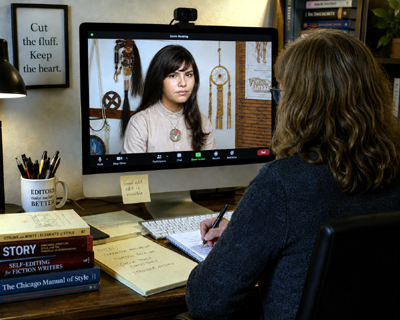
Let's say the assistant thinks the author sounds OK and the manuscript is a contender. Before sending it up the chain, the assistant writes a report summarizing what I discussed above.
The senior acquisition editor gets the summary and when time permits, delves further, perhaps has a Zoom call with the author and takes the proposal to the editorial board's next meeting.
Throughout this process there is a lot of waiting.
Not days.
Not weeks.
But months.
Or never.

If the editorial board gives the manuscript a green light, it is time to go to contract.
See my next newsletter for an inside view of a publishing contract with updates on my debut novel, Becoming Amber.
You can read all newsletters here.
Until then,