Hello there!
Hello there!
And
welcome to Volume 7, Developmental Editor
This is the seventh in a series about the state of fiction writing today along with updates on my debut novel, Becoming Amber, which will be released later this year.
My first newsletter covered the love of writing;
the second, the importance of a good idea;
the third, writing the book;
the fourth, looking for a publisher;
the fifth, the Acquisitions Editor;
the sixth, Contract Terms.
If you'd like to read back issues, go here.
To sign up for future newsletters, go here.
Developmental Editor
Once you've signed a contract, you'll be assigned a project manager and one of the first things she will do is partner you with a Development Editor and send your manuscript to her.
Over the years I have been fortunate to work with wonderful developmental editors. In fact, I had the same editor for over a dozen of my horse books. We clicked. The role of a non-fiction editor is mainly to see if the material in the book is organized, that there is a logical flow of information and the author's voice is appropriate for the intended audience. Plus, she is kept in the loop with the author and the publishing staff regarding illustrations and book design.
"But what does a developmental editor do with a fiction manuscript?" I wondered and soon found out!
She looks at the structure and substance of the book. She looks at the big picture. She focuses on the setting, plot, and characters. She evaluates pacing of action, the arc of the storyline and the development of the protagonist (the main character).
It is kind of like the editor uses your words to get a picture in her head. With this rough draft excerpt from "Becoming Amber", she might come up with the following picture in her mind.
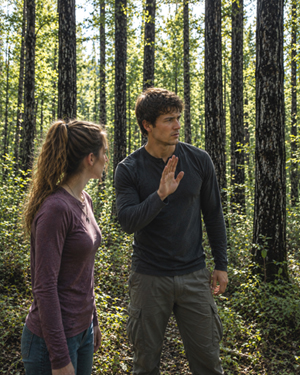
"When I finally saw cottonwoods, I sighed. Thriving, the sixty-foot black trees were a haven for busy birds and small animals. The gentle rustling and scurrying we precipitated was a welcome diversion from the toil of hiking. I noticed the squirrels were smaller compared to the gray bushy-tails in Michigan. Familiar songbirds chirped and swooped. But suddenly, the Disney movie stopped. It became eerily quiet. Bret gestured in some sort of Army sign language for us to be still. He squinted his eyes and pointed to our right. The heavy crunching didn't scare me because I naively thought it was a man walking through the woods, or perhaps a wild horse.
"Realizing it might be a bear, I remembered reading that Alaska had black bears, usually harmless, and brown bears, potentially deadly. With over ten thousand brown bears in Alaska, there was a good chance of us running into one. Although I'd read all about bear habitat, diet, cubs, and hibernation, one thing I didn’t know, was what to do when encountering one."
After reading that section, which occurs early in the book, she might make margin notes asking things like:
- Why isn't Amber scared when she realizes it might be a bear?
- Make sure Bret's army background and hunting experience is mentioned earlier.
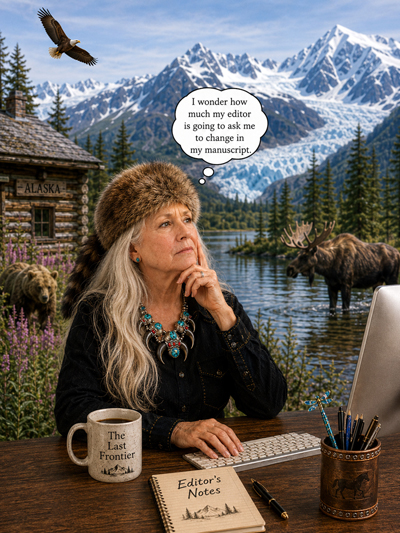
This being my first novel, I wondered how much rewriting I would be doing to satisfy my new editor's criteria while retaining my voice and the story I wanted to tell.
Feedback
For Becoming Amber, I was assigned to a polite, professional, proficient, perfect editor! She typed up a long letter summarizing her main points and made notes in the margin of my manuscript. After she sent me that, we talked on the phone, mainly to go over what she had sent, to see if I had any questions.
She identified scenes she particularly liked, descriptions that made her feel like she was right there in Alaska, and relationships that worked well. I wasn't surprised by anything she said because I had previously worked with another editor on the manuscript and had gotten similar feedback.
But my new editor also suggested I create more tension, that readers want to be on the edge of their seat the entire ride. Hmm.
And she wanted to understand why the heck a young girl would go to Alaska in the first place! Well, for me that isn't hard to imagine since I have always been an adventurous risk-taker and I did live in Alaska! But for a lady sitting at a desk in an east coast office, I can see where the bears and mosquitoes might be a bit too much.
My Way
After our call, I took all of her comments and suggestions to heart, implemented some but kept some sections intact that I'd intentionally created that way to establish my style. The main things I added were small sections that fleshed out descriptions of the Alaska landscape, weather, wildlife, and people.
I sent the manuscript back to her a week later, which seemed to floor her. She said she was amazed I'd added all those extra descriptions in such a short period of time.
The manuscript was good to go.
Next stop, copy editing.
But wait!
While developmental editing was going on, the cover was also being designed!
At this point, I'm not sure what the subject of the next newsletter is going to be - cover design or copy editing. Stay tuned!
Until
then,