Mitchell
Zephier - Lakota | |||||||||||||
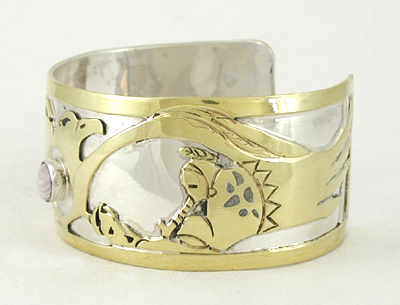
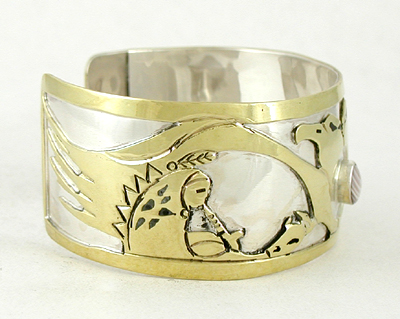
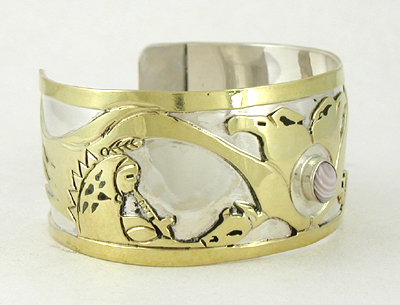
Double eagles with agate cabochon.
About Native American authenticity.
| Mitchell
Zephier, Lakota NBS555 - $550 plus s/h | ||||||||||||
Figure smoking a pipe on each side.
| |||||||||||||
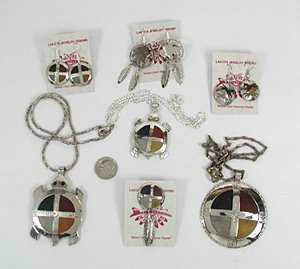
Mitchell Charles Zephier Mitchell Zephier of Rapid City, South Dakota grew up on the Cheyenne River and Rosebud Indian reservations. In 1981 he founded Lakota Visions, traditional Lakota made Native American arts, crafts and jewelry from the plains states. He has mentored over 34 apprentices in metal-smithing and marketing. Family members and friends that work on Lakota Visions jewelry include his son Wakinyan Luta Zephier , Belle Starboy, Webster Two Hawk Jr., and Roger Dale Herron.
Mitch has other forms of artistic expression. His album Cherish the Children won a National Native Music Award for Best Children's Album. Mitchell Zephier's latest venture is to team up with fellow artists to explore, on film this time, the issues that affect the lives of Native Young People in Cloud Horse Production's Lakota 4 Life, a Zephier inspired look at the issues, decisions, responsibilities and opportunities facing Native Youth today. |
What is Nickel Silver?Nickel silver, also called German silver, contains copper, zinc and nickel, but no silver. Navajos occasionally used it in place of coin silver and sterling silver, usually in earlier work. German silver was sold in flat sheets and the Navajo originally obtained this metal from their neighbors, the Utes, who worked it in the plains style of metalwork. Most tribes of the plains, prairies, and Great Lakes areas worked in German silver. German silver is very hard and generally must be machined. Many people are allergic to nickel and get what is called "nickel itch" when contacting nickel silver. |
What is Overlay?Native American overlay pieces are made of two layers of sterling silver. The bottom layer is a solid piece while the top layer has a cutout design. The cutout layer is placed over the bottom layer and the two pieces are "sweated" together, heated so that they become one solid piece of sterling silver. The bottom layer, or background, that shows through the cut out portion of the top layer is often darkened for contrast. Hopi silversmiths typically texture the background layer with hash marks while Navajo artists often leave the background smooth. Hopi artists tend to use geometric designs and symbols similar to those used in their pottery and baskets. Navajo silversmiths tend to create scenes depicting everyday life using people, animals, buildings and landscapes to tell a story - this style is called "overlay storyteller jewelry". Read more about overlay here. |


 Mitch
has won numerous awards including first place at Red Earth Show, several awards
at the internationally prestigious Sante Fe Indian Market as well as presented
his work at far off Native American venues like Schimutzun Celebration in Connecticut.
He has also earned the South Dakota Governor's award.
Mitch
has won numerous awards including first place at Red Earth Show, several awards
at the internationally prestigious Sante Fe Indian Market as well as presented
his work at far off Native American venues like Schimutzun Celebration in Connecticut.
He has also earned the South Dakota Governor's award.