Phillip
and Lenore Garcia, Navajo |
Earrings 1 3/8" long including wires.
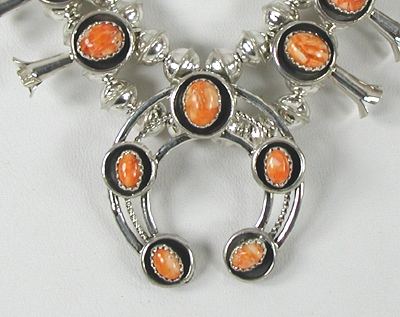
Naja is 1 1/2" tall x 1 1/2" wide. | Phillip
and Lenore Garcia, Navajo SQ08 - $595 plus s/h | |||||||||
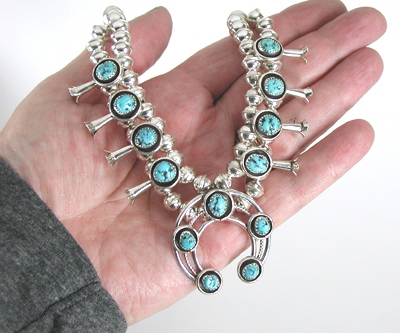
Above is a turquoise necklace of the same size to show scale.
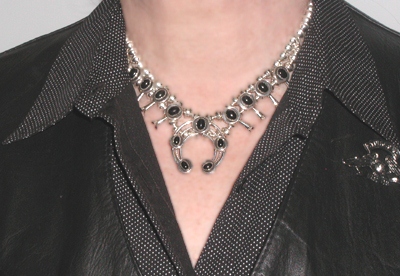
Above is the same necklace in onyx to show scale. | ||||||||||
Squash Blossom SymbolismCorn, squash and beans are the traditional mainstays of the southwestern diet, culture and symbolism and are used in many ways in art and ceremony. The squash blossom represents abundant life. Read more . . . |
What is the Naja Symbol?The horseshoe shaped naja originated with the Moors in Spain. It is a good luck charm to ward off the evil eye. It was often used on the browband of Moorish Horses. It is thought that it came to Mexico via the Spanish Moors and from there was adopted by the Navajo Indians. The naja is the base pendant of many ornate squash blossom necklaces: read more . . . |
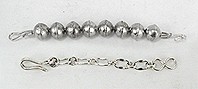
What are Bench Beads?Bench beads are partially manufactured and partially hand made. Usually the halves are machine cut and the silversmith solders the two halves together. Sometimes bench beads are left with a protruding seam but in other cases the seam is sanded down and polished smooth. Then the beads are strung by hand. |
What is Spiny Oyster?Spiny oyster, not surprisingly, is an oyster that is covered with spines. Like coral or mother-of-pearl, the shell of spiny oyster is considered an organic gemstone. The portion of the shell used to make jewelry is aragonite, which consists of calcium carbonate (CaCO3). Aragonite has the same chemical formula as calcite. Spiny oysters are found along the Atlantic coast of Baja California and Baja Mexico. Common colors vary from orange, found in shallow waters, to red and purple from deeper waters. The shell is also found in white, yellow, pink and brown. Polished shell has definite striations and color variation. Red spiny oyster has been used as a subsititute for coral. |