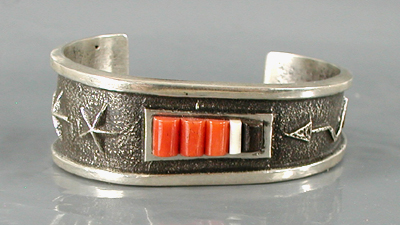
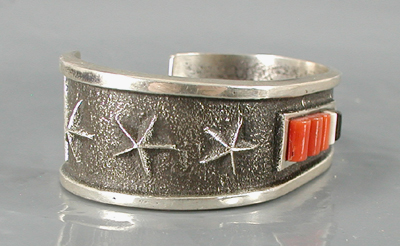
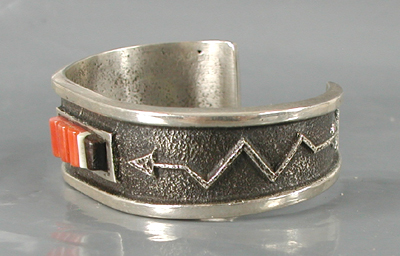
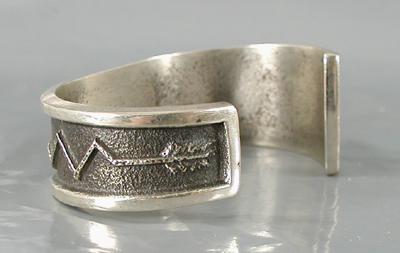
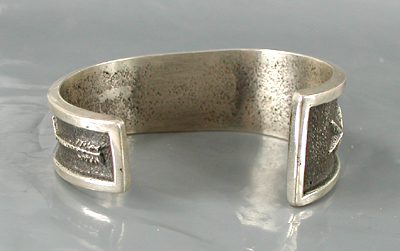
Aaron Anderson, Navajo - Sterling Silver | ||||||||||
Aaron Anderson, Navajo NBT734
- $425 plus
s/h | ||||||||||
About Native American authenticity.
| ||||||||||
What does Tufa Cast mean?Tufa cast, or sand cast, items are made using a procedure developed by Navajo silversmiths in the mid 1800s. It is a labor-intensive process that involves many steps. First, the artisan carves the design of the item being cast into the flat surface of a stone. Stones typically used are tuff, a porous volcanic ash material; tufa, a porous limestone that forms near hot springs; and sandstone, which is somewhat harder. Next, another smooth flat stone is placed against the carved half of the mold. The halves are fastened together and a sprue hole is carved into one end. Molten silver is poured into the mold through the sprue hole. Once the silver cools, the halves are separated and the item is taken out and finished. Bracelets are poured flat and then shaped. Read more . . . |
About Red CoralRed Coral is the common name given to Corallium Rubrum and several related species of marine coral. Red coral is a collection of hundreds of tiny animals living together in a colonies that resemble small leafless bushes growing on dark, rocky seabottom. The coral skeleton is composed hard calcium carbonate, colored in shades of red from pale pink to deep red. It can be semi-translucent to opaque. It is naturally matte, but can be polished to a glassy shine. Red coral is frequently dyed to enhance color and it can also be impregnated with resins or epoxies to fill surface fissures and flaws. Coral jewelry has been found in ancient Egyptian and prehistoric European burials. The Romans believed coral could protect children from harm, as well as cure bites from snakes and scorpions and diagnose diseases by changing colour. Read more . . . |
About Silver100% solid silver won't tarnish but it is too soft to use for making jewelry - it could easily be scratched, dented and bent. Sterling silver has a small amount of one or more other metals usually copper, added to the silver. To be called sterling silver, the alloy must contain at least 92.5% pure silver. Sterling silver alloy is harder than pure silver but the added metals also can cause discoloration or tarnish. |