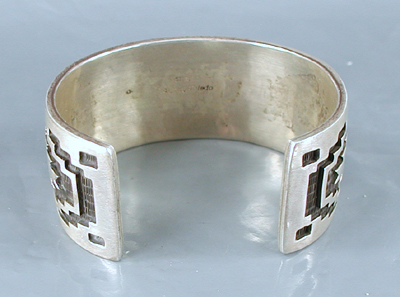
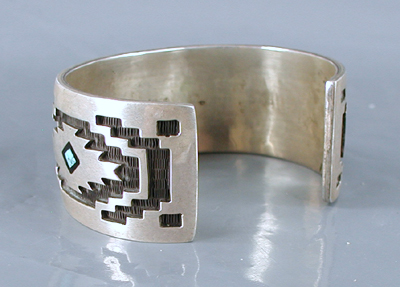
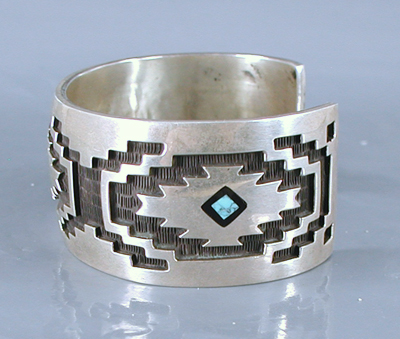
Randy Toledo, Navajo | ||||||||||
Randy Toledo, Navajo NBT735
- $371 plus
s/h | ||||||||||
About Native American authenticity.
| ||||||||||
What is Overlay?Native American overlay pieces are made of two layers of sterling silver. The bottom layer is a solid piece while the top layer has a cutout design. The cutout layer is placed over the bottom layer and the two pieces are "sweated" together, heated so that they become one solid piece of sterling silver. The bottom layer, or background, that shows through the cut out portion of the top layer is often darkened for contrast. Hopi silversmiths typically texture the background layer with hash marks while Navajo artists often leave the background smooth. Hopi artists tend to use geometric designs and symbols similar to those used in their pottery and baskets. Navajo silversmiths tend to create scenes depicting everyday life using people, animals, buildings and landscapes to tell a story - this style is called "overlay storyteller jewelry". Read more about overlay here. |
ABOUT TURQUOISE Turquoise is associated with the sky,
and bringing sky energy to earth. It is known as a master healer stone as it is
believed to help speed the healing process. It is also thought that turquoise
can help promote honest and clear communication from the heart. |
About Red CoralRed Coral is the common name given to Corallium Rubrum and several related species of marine coral. Red coral is a collection of hundreds of tiny animals living together in a colonies that resemble small leafless bushes growing on dark, rocky seabottom. The coral skeleton is composed hard calcium carbonate, colored in shades of red from pale pink to deep red. It can be semi-translucent to opaque. It is naturally matte, but can be polished to a glassy shine. Red coral is frequently dyed to enhance color and it can also be impregnated with resins or epoxies to fill surface fissures and flaws. Coral jewelry has been found in ancient Egyptian and prehistoric European burials. The Romans believed coral could protect children from harm, as well as cure bites from snakes and scorpions and diagnose diseases by changing colour. Read more . . . |
About Silver100% solid silver won't tarnish but it is too soft to use for making jewelry - it could easily be scratched, dented and bent. Sterling silver has a small amount of one or more other metals usually copper, added to the silver. To be called sterling silver, the alloy must contain at least 92.5% pure silver. Sterling silver alloy is harder than pure silver but the added metals also can cause discoloration or tarnish. |