Home
| About Us
| Articles |
Shopping | Contact
| Site
Map | Search
Home
| About Us
| Articles |
Shopping | Contact
| Site
Map | Search
Home
| About Us
| Articles |
Shopping | Contact
| Site
Map | Search
HK
Item #FT303 | |||||||||
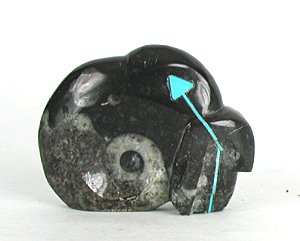
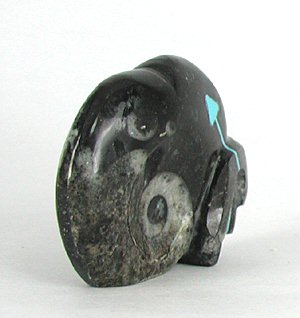
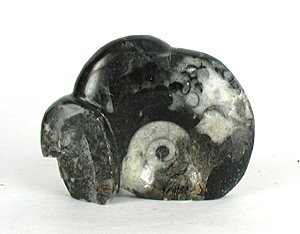
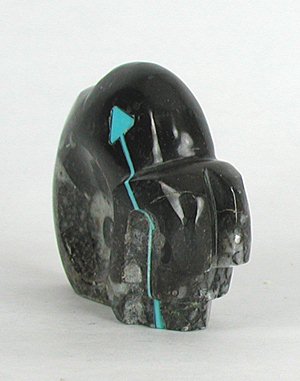
Ammonite buffalo with turquoise inlaid heartline.
| "Ancient
Earth Power" FT303 - $85 SOLD | ||||||||
Paula says - "This amazing buffalo was living in the stone as a fossil seashell for eons until Kenric Laiwakete saw it and brought it out! Kenric inlaid a turquoise heart line to enhance the buffalo's healing power. "Fetishes carved from ancient fossils will often show fissures and cracks. Sometimes the fossil is so fragile that when being carved, the rock splits partially or completely across. In a few cases the pieces have been reunited which adds to their wabi-sabi. After all, these specimens are millions of years old!!
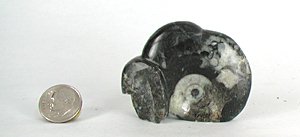
Dime above shows scale of buffalo.
| |||||||||
What is a Fetish? A fetish is a rock carving of an animal that captures the spirit and the essence of the animal, not necessarily its exact detailed conformation. Although carved from many types of rock, Picasso White marble is traditional. Read more about fetishes. Buffalo ("Tatanka" in Lakota), represents prophesy and fulfillment of powers. Buffalo also represents the perseverence and ability to rise above one's weaknesses. Buffalo teaches that everything exists in abundance if it is respected and accepted with gratitude. Heart Line. The heart line is a line etched, painted or inlaid along one or both sides of the animal. It usually extends from the mouth to the region of the heart. There are many interpretations as to what a heart line represents, but it is often said to represent the pathway of the breath of the animal to the life force which is the heart. Others feel that the heart line points to the soul of the animal. It is thought that a heart line gives the fetish healing or medicinal power. Ammonites are an extinct group of cephalopods, or squid-like creatures that thrived in tropical seas until becoming extinct along with the dinosaurs at the end of the Mesozoic era. Their fossilized shells resemble tightly-coiled rams' horns and they were named after the Egyptian god Ammon who was often depicted wearing ram's horns. Wabi-Sabi is the art of finding beauty in imperfection, of accepting natural growth, decay, and death. It reveres authenticity above all else. Wabi-sabi celebrates cracks and crevices and all the other marks that time, weather, and loving use leave behind. It reminds us that we are all but transient beings on this planet-that our bodies as well as the material world around us are in the process of returning to the dust from which we came. | |||||||||