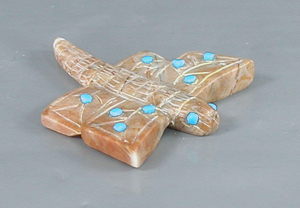
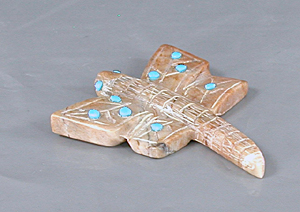
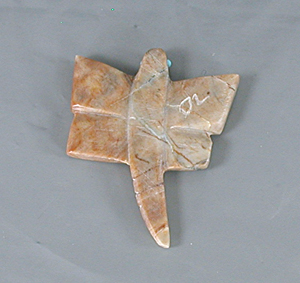
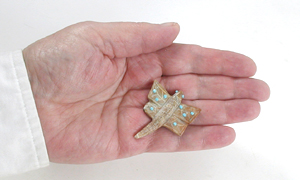
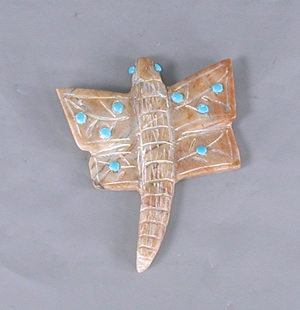
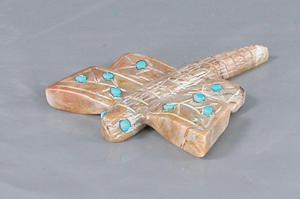
"Flutter" FO359 - $42 plus s/h |
About Native American authenticity.
| ||||||||
Turquoise eyes and power spots.
| |||||||||
What is Picasso Marble?Picasso marble started out as type of limestone found in Utah. When the ocean covered Southern Utah, shells from tiny sea animals turned into limestone. Later, heat and pressure caused calcite in the limestone to recrystallize into marble. Minerals such as clay, mica, quartz, and iron oxides filled seams in the limestone to give the marble a wide variety of patterns and colors - tans, browns, greys, white and black. The name comes from the resemblance of the markings to the paintings of Pablo Picasso. It is perhaps the most popular rock among Zuni carvers, although it has only been used in Zuni since the 1980s. Picasso marble is prized by Zuni carvers for its bold, natural patterning that can enhance the form of the figure. The flowing lines and contrasting patterns may suggest feathers, fur, or movement, adding visual interest without the need for heavy surface detailing. Fetish carvings in Picasso marble are valued for their dramatic appearance and natural artistry. The bold veining ensures that each piece stands out, while still reflecting the skill and tradition of the Zuni carver who shaped it. |
Butterfly Symbolism Butterfly represents transformation, the ability to go through changes in life with grace and lightness, like the plain caterpillar changing into a colorful butterfly. Butterfly's bright colors symbolize liveliness and playfulness. Butterfly helps us look at heavy and tense situations with a new, lighter perspective. |