|
About Native American authenticity.
|
Monty Claw, Navajo | ||||||||||||
|
During my early years, I accompanied my parents on trips every year, usually to Florida to escape the harsh midwest winters but also out west on summer road trips. During those trips, I accumulated the type of tourist grade Native American jewelry that a kid would buy and now, years later those items are referred to as being "Fred Harvey" style. Fred Harvey was an entrepreneur who created an avenue for Indians to make and sell jewelry to the tourists. Jewelry of the Fred Harvey era has typical Indian kitsch of arrows, tomahawks, tipis, thunderbirds and so on and was most produced from 130- throughout the 1950s. You can read more about Fred Harvey here. From childhood through college and beyond, I had an eye for that type of jewelry and collected it, yet rarely wore it !! About the only jewelry I wore for years was a Swiss Army watch and my wedding band. My Mother, also a jewelry lover, gave me a few vintage Native American pieces she had picked up. That really got me interested in older pawn items.Yet I was a collector, not a wearer. Then suddenly, about ten years ago I started wearing first one Native American item, then another and soon I felt incomplete if I didn't wear at least one bracelet and necklace or pendant. Now I wear rings, belt buckles, watches and all things Native American. My favorites include lapis lazuli items, water bird pendants, Hopi bracelets and pendants, anything with Man in the Maze on it, silver beads, heishi of all kinds, storyteller bracelets, rings of all kinds, all kinds of fetishes and more. Once I started working here at Horsekeeping and they added Native American jewelry to the website, my personal collection quickly outgrew my jewelry box.....so much so that I had to make a rule. Maybe some of you have done this with the clothes or shoes or purses in your closet. For every new item I bring into my personal collection, I must trade out at least one item. I've been doing this for years and now have quite a box of items that I will list in my own section "Paula's Collection". When I first began collecting Native American items, I didn't realize the importance of knowing the artist's name - if I liked something and wanted it, I bought it. But now with all of our personal contacts with artists, our reference library, and our interest in providing as much information as we can to our customers, we are all very interested in finding out the artist's name, relatives, and tribal affiliation. So I'll do my best to give you the most information I can on each piece. I hope you enjoy browsing through our pawn shop - and Paula's Collection - it is a treasure trove of American History! |
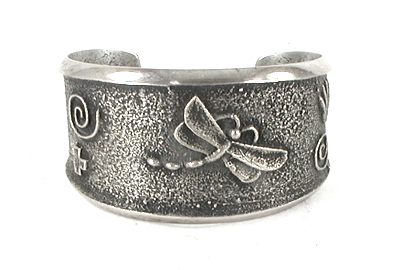
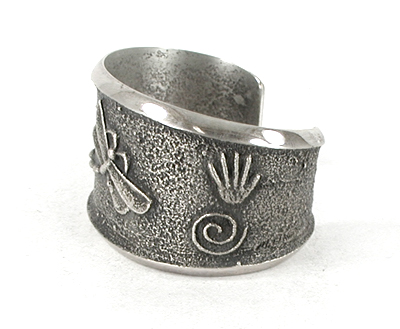
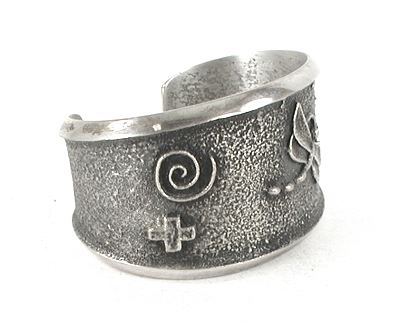
Dragonfly SymbolismIn Plains Indian traditions, dragonflies are symbols of protection and invincibility. Pictures of dragonflies were often painted on war shirts and tepees to ward off danger. Dragonfly symbolizes change and the stripping away of all negativity that holds us back, helping us to achieve our dreams and goals. Dragonfly is the keeper of dreams that sees all of our true potential and ability and helps us on the path of discovery and enlightenment. Dragonfly reminds us that anything is possible. |
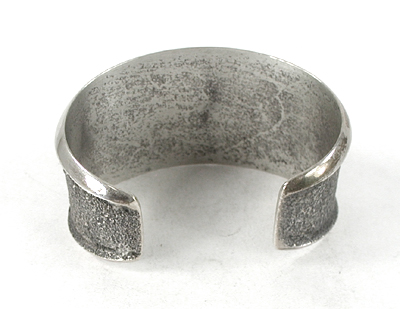
What does Tufa Cast mean?Tufa cast, or sand cast, items are made using a procedure developed by Navajo silversmiths in the mid 1800s. It is a labor-intensive process that involves many steps. First, the artisan carves the design of the item being cast into the flat surface of a stone. Stones typically used are tuff, a porous volcanic ash material; tufa, a porous limestone that forms near hot springs; and sandstone, which is somewhat harder. Next, another smooth flat stone is placed against the carved half of the mold. The halves are fastened together and a sprue hole is carved into one end. Molten silver is poured into the mold through the sprue hole. Once the silver cools, the halves are separated and the item is taken out and finished. Bracelets are poured flat and then shaped. Read more . . . |
About Silver100% solid silver won't tarnish but it is too soft to use for making jewelry - it could easily be scratched, dented and bent. Sterling silver has a small amount of one or more other metals usually copper, added to the silver. To be called sterling silver, the alloy must contain at least 92.5% pure silver. Sterling silver alloy is harder than pure silver but the added metals also can cause discoloration or tarnish. |
About the Artist, Monty Claw
Monty is now working with jewelry and metal smithing. These are works of silver and gold occasionally set with precious gems like turquoise, coral, and diamonds. The pieces he creates are of high quality, with artistic creativity, fine details, and very sculptural definitions that make them come to life. His work is recently sought after by major collectors, museum board members, and major curators. With the support of his family and peers he continues to explore jewelry and metal smithing with a vision of his own setting a path for his stories in the form of art. He has only began jewelry and metal smithing in 2011. Along the way came awards from distinguished events like the SWAIA Santa Fe Indian Market, The Heard Museum Indian Market, and Cherokee Art Market in Tulsa, Oklahoma. Monty continues to grow with knowledge and success as one of today’s and into tomorrow’s light as a ground breaking artist. |
Our
Rescue Mission |
NOTE: Items in our Vintage Shop are either USED or NEW. They might come from inheritances, estate sales, private collections, and store liquidations. Many items are brand new (, New Old Stock) and in perfect condition while others may show tarnish, scratches and other signs of use. Major issues will be described in detail and shown in photos. Vintage Shop items are sold as described and are not returnable |
Horsekeeping
LLC - Definitions of Jewelry Age and Condition © 2015 Horsekeeping LLC © Copyright Information | |
Patina | A dark or colored film of oxidation that forms naturally on metal exposure to air and other elements. It is often valued for its aesthetically pleasing appearance. |
Vintage | 30 years or older. |
NOS | New Old Stock. Retail store inventory from at least 10 years ago. |
Pre-owned | An item that has been used. |




 With
a long time experience in multiple art forms, Monty Claw of the Navajo Nation
from Gallup, New Mexico is a successful artist in which ever medium he uses. Being
self taught and some studies at The Institute of American Indian Arts, he has
taken on being one of the prominent artists of today. Currently he works with
jewelry, metal smithing, painting, beadwork, and feather fan making. Monty has
been in many publications like The Smithsonian Magazine, and Native Peoples Magazine.
He has museum quality collections with the Nelson Atkins, The Nerman Museum, Minneapolis
Institute of Arts, The Denver Art Museum, The Sam Noble Museum, and Musée Du Quai
Branly in Paris, France.
With
a long time experience in multiple art forms, Monty Claw of the Navajo Nation
from Gallup, New Mexico is a successful artist in which ever medium he uses. Being
self taught and some studies at The Institute of American Indian Arts, he has
taken on being one of the prominent artists of today. Currently he works with
jewelry, metal smithing, painting, beadwork, and feather fan making. Monty has
been in many publications like The Smithsonian Magazine, and Native Peoples Magazine.
He has museum quality collections with the Nelson Atkins, The Nerman Museum, Minneapolis
Institute of Arts, The Denver Art Museum, The Sam Noble Museum, and Musée Du Quai
Branly in Paris, France.