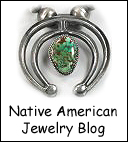
Sand
Cast Sterling Silver |
About Native American authenticity.
7/8" long old style pin and 1/16" loop opening lets you wear this as a pin or as a pendant. |
Sand Cast Sterling Silver P481
- $165 plus s/h | ||||||||||||
Paula
says - "In my opinion, this naja pin pendant shows design characteristics
and workmanship of being Navajo made. But because there is no hallmark
that we can attribute to a specific artist we can't legally sell it as Native
American made - read more."
|
What is the Naja Symbol?The horseshoe shaped naja originated with the Moors in Spain. It is a good luck charm to ward off the evil eye. It was often used on the browband of Moorish Horses. It is thought that it came to Mexico via the Spanish Moors and from there was adopted by the Navajo Indians. The naja is the base pendant of many ornate squash blossom necklaces: read more . . . |
ABOUT TURQUOISE Turquoise is associated with the sky,
and bringing sky energy to earth. It is known as a master healer stone as it is
believed to help speed the healing process. It is also thought that turquoise
can help promote honest and clear communication from the heart. |
About Silver100% solid silver won't tarnish but it is too soft to use for making jewelry - it could easily be scratched, dented and bent. Sterling silver has a small amount of one or more other metals usually copper, added to the silver. To be called sterling silver, the alloy must contain at least 92.5% pure silver. Sterling silver alloy is harder than pure silver but the added metals also can cause discoloration or tarnish. |
What does Tufa Cast or Sand Cast or mean?Native American cast items are handmade items using one of several processes and materials. Sand casting was developed by the Egyptians and introduced to the Dine’ (Navajo) in the 1880s. This method uses sand with a high clay content to form a mold from a template, an existing piece of jewelry or sculpture. Two halves of a box are filled with sand and the original piece is placed between them so the sand packs around the template to form an impression of the original piece.The boxes are carefully separated and the original piece is removed leaving behind an impression of the piece. A sprue (hole into which the molten metal is poured) and air vents are formed from the impression cavity to the edges of the mold and the two boxes are then bound together. Molten metal is poured into the sprue to fill the mold and allowed to cool. The box is separated and the newly cast piece is removed and finished by grindng, filing and polishing. Tufa casting is used by many Navajo casters today to make an original piece of jewelry or sculpture. Using Tuff Stone, a porous rock from volcanic ash, Tufa Stone, a porous limestone that forms near hot springs, or Sandstone, a harder stone, the artist carves out an original design of an item to be cast, taking care to make the edges angle outward so the metal doesn’t stick into corners when the halves are later separated. A sprue is carved from one edge of the cavity to the edge of the form. Another flat stone is placed against the carved half of the mold. The halves are fastened together and molten metal is poured into the mold through the sprue. Once the metal cools, the form is separated and the casting is taken out and finished. Depending on the preparation of the form and the porous nature of the stone, cast items might have characteristic small pits. That is the nature of sand and tufa casting and Indian Hand Made. |
Our
Rescue Mission |
NOTE:
Items in our Vintage Shop are either USED or NEW. They might come from inheritances,
estate sales, private collections, and store liquidations. Many items are brand
new (NOS, New Old Stock) and in perfect condition while others may show tarnish,
scratches and other signs of use. Major issues will be described in detail and
shown in photos. Vintage Shop items are sold as described and are not returnable. |
Horsekeeping
LLC - Definitions of Jewelry Age and Condition | |
Patina | A dark or colored film of oxidation that forms naturally on metal exposure to air and other elements. It is often valued for its aesthetically pleasing appearance. |
Vintage | 30 years or older. |
NOS | New Old Stock. Retail store inventory from at least 10 years ago. |
Pre-owned | An item that has been used. |