| Five Bears Bead NecklaceHK Item #BBN308All Jewelry < Vintage Jewelry < Bargain Barn < Necklaces
|
| Five Bears Bead NecklaceHK Item #BBN308All Jewelry < Vintage Jewelry < Bargain Barn < Necklaces
|
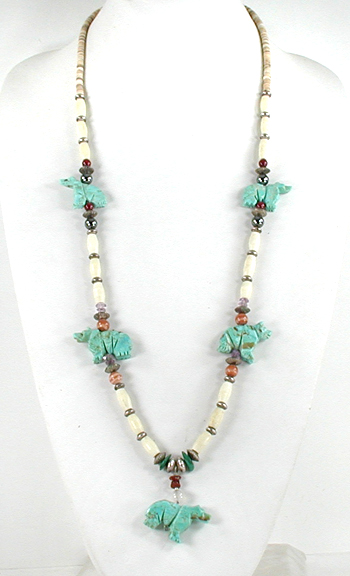
Five bears 1 3/8" long with 5 mm melon shell heishi, hair pipe beads and other beads.
|
Five Bears Bead Necklace BBN308
- $75 plus s/h | |||||
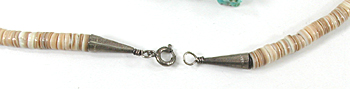
Ring clasp. | ||||||
Native American Bear SymbolismBear is considered the most powerful of all of the animals and is one of the most popular subjects of Native American carvers. Bear is a spiritual guide and represents strength and self-knowledge. Bear has supernatural powers and great healing powers. Bear is a symbol deliberate action, introspection, soul and insight for the past and the future. The Bear is the guardian of the West an is one of the animals of the Six Directions. Bears are the main figure in the Mountain Way, an important Navajo ceremony. Bear claws are a traditional adornment to pendants and bracelets. |
About Block TurquoiseBlock turquoise is comprised of epoxy, dye, and crushed stone. Block turquoise is often more consistent in color, pattern and hardness than natural stone and is more suitable for applications such as fine carving and inlay knife handles or rings that may be subject to abrasion and moisture. |
What is heishi? Heishi means shell and
in the past, referred to pieces of shell that have been drilled and hand rolled
or ground into bead shapes and strung as necklaces. With the reduced availability
of some shell materials, the modern Native American artists also use hand made
beads of other natural materials including stones when making heishi necklaces.
Read more about heishi.
|
Bone Hair Pipe BeadsHair pipe beads are long hollow beads usually, but not always, having tapered ends. The term "hair pipe" was likely coined by early white traders who saw indians wearing the long beads as hair ornaments. Hair pipes are thought to have been originally made of conch shell by southeastern Indians (Chickasaw, Creeks, and Cherokee).Some of the oldest shell hair pipes, discovered in Tennessee, are estimated to be from 4,000 years ago. Hair pipes of bone appeared around the late 1800s when white traders brought corn cob pipes to the Ponca Indians of the midwest - the Poncas found that the bone pipe stems made excellent hair pipes. Later, hair pipes were made of glass, brass, silver, horn and other materials. |
Our
Rescue Mission |